
In this guide
- Tools that touch you must be sanitized right after each use.
- Used towels go into a closed container or covered bin straight away.
- Anything dropped on the floor must be sterilized before it is used again.
Key takeaways
- Pennsylvania’s State Board of Cosmetology sets sanitation rules that apply to every nail salon.
- Look for clean towels kept in a closed cabinet, a covered waste bin and tools stored in a closed container.
- Your technician should wash their hands right before working on you.
- Good light and ventilation are requirements, not extras.
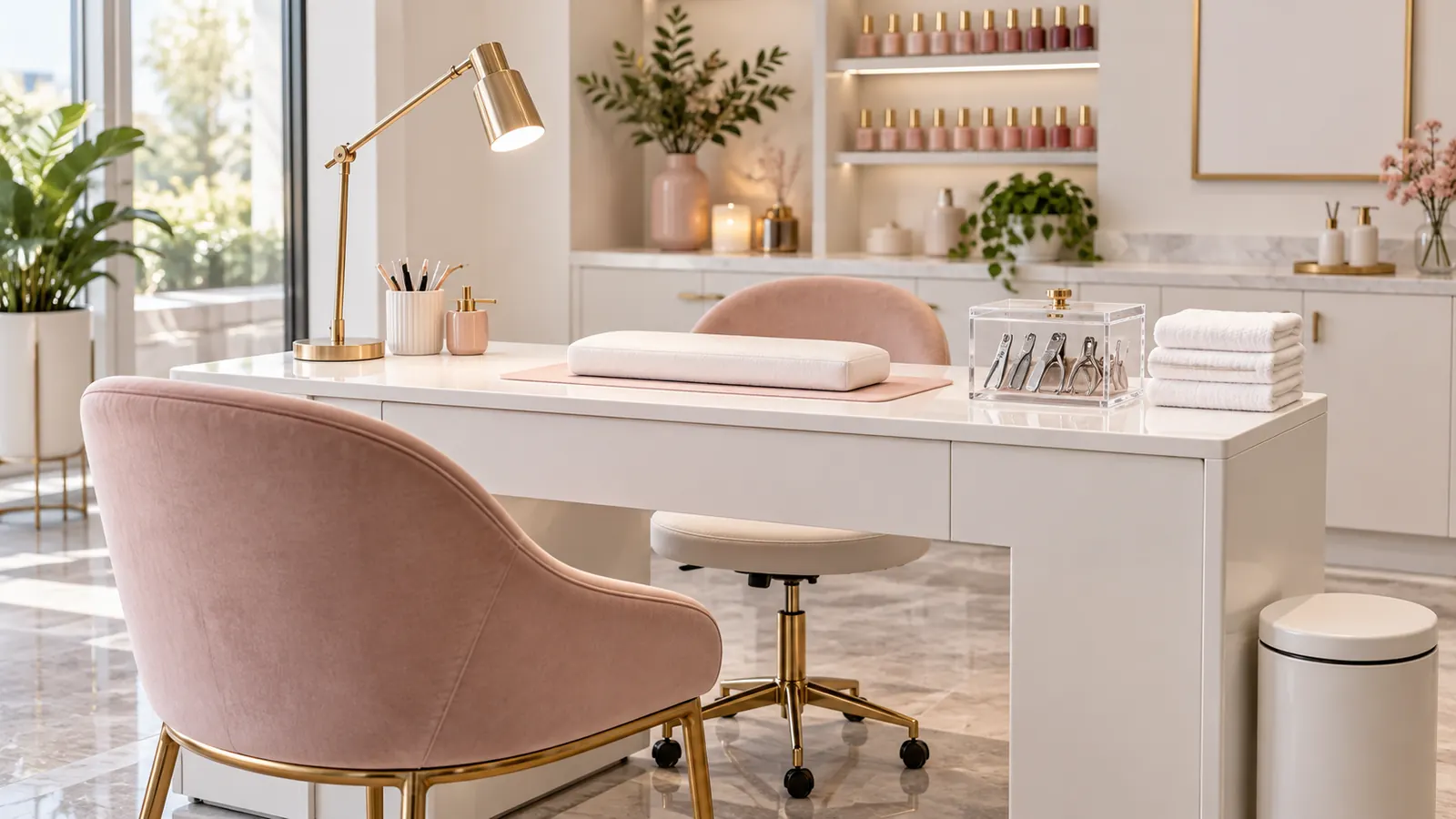
You can learn a lot about a nail salon before you sit down. Pennsylvania’s State Board of Cosmetology has a set of health and safety rules that apply equally to cosmetology salons and to salons that offer only nail services. Most of them are things a customer can see. This guide turns those rules into a short checklist, so you know what normal looks like and what is worth a question.
The room itself
The first rule is the most basic: a salon must be well lighted and well ventilated, and every area, including the floors and the restrooms, has to be kept in a safe, orderly and sanitary condition. A salon also needs adequate restrooms within its own space.
Ventilation matters more in a nail salon than in most shops, because polishes, removers and acrylic liquids give off vapors. If the air is heavy with chemical smell the moment you walk in, that tells you something about how the room is ventilated. Our guide to That Nail Salon Smell: Ventilation, Dust and What OSHA Recommends explains what federal safety officials recommend.
What should be at every station
The Board lists the minimum equipment a nail technology salon must have for one technician, and requires more as the number of technicians grows so each can work safely. The list includes:
- a chair for manicures and pedicures, and a manicure table with a light, a chair and a stool;
- a pedicure basin and stand;
- a wet sanitizer, and a closed container for sanitized implements;
- a covered waste container and a closed storage area for soiled linen;
- a closed towel cabinet for clean linen, with twelve sanitary towels for each work station;
- a sink with hot and cold running water that is readily accessible to each work station;
- a labeled first aid kit, and a fire extinguisher rated for Class A, B and C fires.
You will not see all of this from the chair, and you do not need to. But the closed containers are telling. Clean tools waiting in a closed container, clean towels kept behind a door and a bin with a lid are the visible part of a salon that follows the rules.
Tools: sanitized after every client
The rule on equipment is short and strict. Tweezers and other tools, instruments, utensils and appliances that come into contact with a client must be sanitized immediately after each use and kept in a sanitary condition at all times. Sharp implements must be stored upright with the points down, or in a protective case.
Two related rules are worth knowing. Creams and other semisolid products have to be taken out of their jars with a sterile spatula or similar utensil, not with fingers, and that spatula cannot touch another client until it is properly disinfected. And any article that has been dropped on the floor or otherwise made unsanitary has to be sterilized before it is reused.
Tip: Watch where your technician’s tools come from. Implements taken out of a closed container or a fresh pouch are a good sign; tools pulled from a drawer of loose files are worth a question.
Towels and supplies
Only clean cloth towels or disposable paper towels can be used on clients. Unused cloth towels must be kept in a closed cabinet, and unused paper towels in a closed cabinet or a closed dispenser. Once a cloth towel has been used on a client, it goes straight into a closed container for soiled linen. A used paper towel goes straight into a covered waste container.
The rules also ban two old salon habits outright: powder puffs and styptic pencils may not be used. If a small cut bleeds, only a powdered or liquid astringent applied with a clean towel or a clean piece of cotton may be used to stop it.
The person doing your nails
Every salon employee who serves the public must be clean in person and dress, and must thoroughly wash their hands immediately before working on a client and immediately after using the restroom. Technicians who use chemicals must follow the manufacturer’s directions and the FDA instructions on the container or packaging.
There is also a rule about illness. A licensee must refuse to serve a client they believe has an infectious, contagious or communicable disease, unless the client can produce a physician’s certification saying they do not. So if a technician declines to work on an infected nail, they are following the rules, not being rude.
A five-minute checklist
| Look for | Why it matters |
|---|---|
| The salon license on display | Required in a conspicuous place; see How to Check a Pennsylvania Nail Technician or Salon License |
| Good light and fresh air | Salons must be well lighted and well ventilated |
| Tools from a closed container | Implements must be sanitized after each use and stored that way |
| Clean towels behind a door | Unused towels belong in a closed cabinet or dispenser |
| A lidded waste bin | Used paper towels go straight into a covered container |
| Your technician washing up | Hands must be cleaned right before each client |
When something looks wrong
Most problems are easy to raise on the spot. Asking for a fresh file or for a tool to be cleaned is a normal request. If what you see points to a bigger issue, such as tools reused without cleaning or no license on display, you can leave and report it. The Pennsylvania Department of State accepts complaints about licensed salons and technicians; Filing a Complaint About a Pennsylvania Nail Salon or Technician explains how. For the pedicure chair in particular, read Pedicure Safety in Pennsylvania: What the Rules Require and What to Watch For before your next visit.